What a market structure trading strategy is
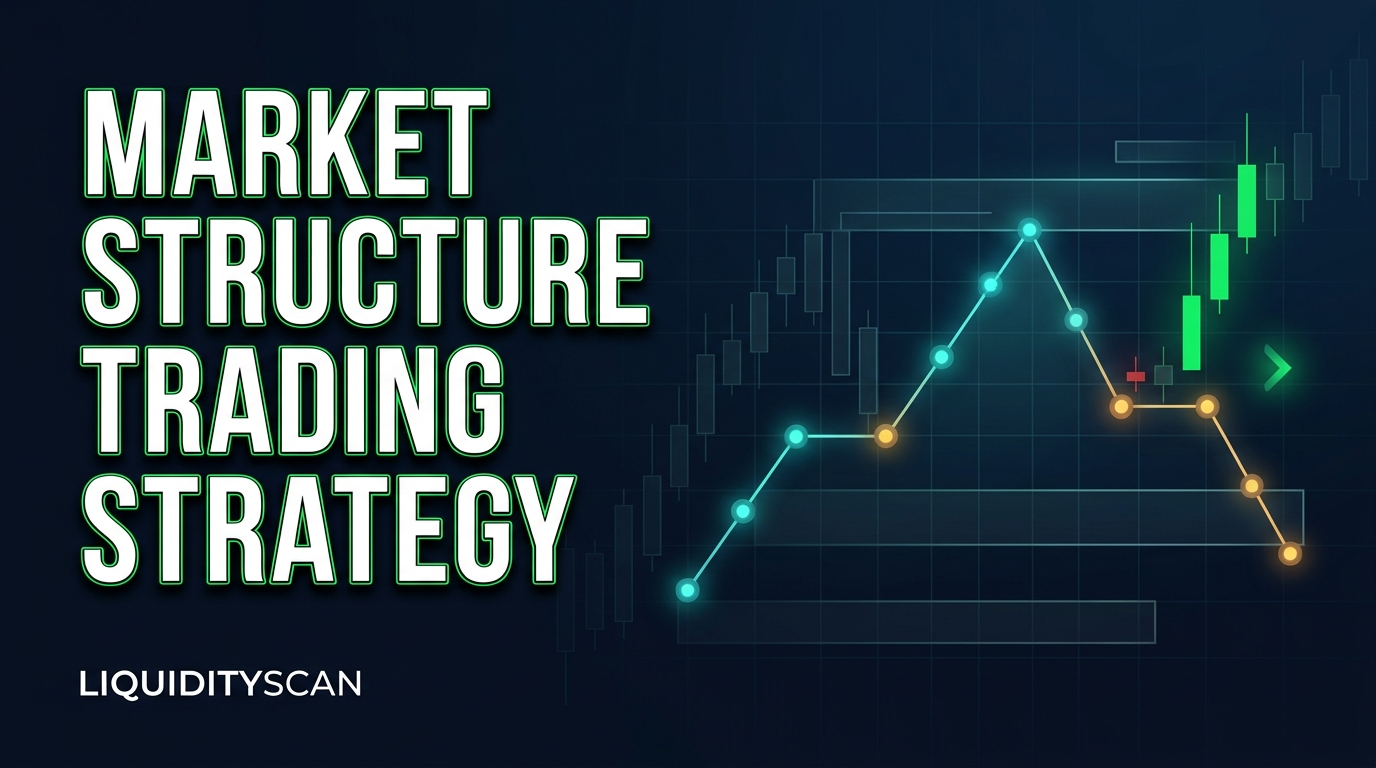
A market structure trading strategy reads the order in which price breaks its own swing highs and swing lows, then trades the pullback that follows a break, with the stop behind the swing that produced it. One break tells you little. The last two or three, read in order, tell you whether you are in a trend, at the first confirmation of a reversal, or in chop that no structure rule will fix.
Each of those orders is a playbook. Below are ten of them, how each one trades, where each one fails, and how to see which markets just completed one on the LiquidityScan Structure Map.
The two events every playbook is built from
Structure starts with swings. A swing high is a high with lower highs on both sides, and a swing low is the mirror. The three-candle rule for marking swing highs and lows covers the details. Two things can happen to a swing:
- BOS (break of structure): a candle closes beyond the last swing in the direction the market was already moving. In an uptrend, that is a close above the last swing high.
- CHoCH (change of character): a candle closes beyond the last swing against that direction. In an uptrend, that is a close below the most recent higher low.
The close is what counts. A wick that pokes above a swing high and closes back under it is a liquidity sweep (a run on the stops resting past a level), not a break. If you mix the two up, every playbook below gives the wrong reading. The guide to BOS vs CHoCH goes deeper on the definitions, and the article on failure swings versus real breaks of structure covers the wick case.
Picture a 4H chart stepping upward. Price makes a swing high and pulls back to a higher low, then a candle closes above that high: BOS. It pulls back again, holds a new higher low and closes above the next high: a second BOS. Then a candle closes below the latest higher low: CHoCH. Those three events in that order describe one situation. The same three in another order describe a different one.
Ten structure playbooks at a glance
The names below are the plain-language descriptions LiquidityScan uses for pre-built structure sequences. The second column is how each description reads in BOS and CHoCH terms, oldest event first.
| Playbook | Reads as | What it tells you | What a trader waits for next |
|---|---|---|---|
| Trend continuation | BOS, BOS | Two breaks in a row in the trend's direction | A pullback into the leg behind the second break |
| Confirmed reversal | CHoCH, BOS | The trend flips, and the next break confirms it | The first pullback in the new direction |
| Exhaustion | BOS, CHoCH | A continuation, then an immediate reversal | A confirming break before trusting the turn |
| Confirmed reversal, extended | CHoCH, BOS, BOS | A fresh trend takes hold | Pullbacks, knowing the move is no longer early |
| Pullback flip | BOS, CHoCH, BOS | Trend, reversal, then confirmation the other way | The first pullback after the confirming break |
| Failed reversal | CHoCH, BOS, CHoCH | It flips, confirms once, then fails | The original direction to prove itself with a new break |
| Chop resolves | CHoCH, CHoCH, BOS | Back-and-forth that finally picks a side | A retest of the range edge that was broken |
| Trend, then turn | BOS, BOS, CHoCH | Momentum that finally reverses | A confirming break; until then it may be a deep pullback |
| Trend into chop | BOS, CHoCH, CHoCH | A push, then two reversals | Nothing yet: mark the range and wait |
| Pure whipsaw | CHoCH, CHoCH, CHoCH | Three reversals in a row (rare) | Nothing: the swings are not holding |
Trend playbooks: Trend continuation and Confirmed reversal, extended
Both end on a BOS that follows another BOS. In an uptrend, the swing low that price launched from to make the latest break is now the level the trend depends on. The usual plan is to wait for price to come back into the lower half of that leg. The preferred landing spot is an order block (the last opposing candle before the move that broke structure) or a fair value gap, or FVG (the three-candle gap a fast move leaves behind). The entry idea is the reaction there.
The idea is invalid when a candle closes below that launch swing low. That close is a CHoCH by definition, and the playbook has become Trend, then turn. The limit is timing. Every extra BOS means you are later in the move, and a strong trend may never pull back far enough to reach your zone. The article on telling continuation setups from reversal setups helps when the pullback starts to look like more than a pullback.
Reversal playbooks: Confirmed reversal and Pullback flip
A CHoCH alone is a warning. In an uptrend, a close below the last higher low may be nothing more than a deeper pullback on the timeframe above. The confirmation is the next event. Price bounces into a lower high, then closes below the low the CHoCH leg set. That is a BOS in the new direction, and it is what turns a flip into a Confirmed reversal. When a visible trend break came first (BOS, then CHoCH, then BOS the other way), the same thing is called a Pullback flip.
The entry idea is the first pullback after the confirming break, back toward the origin of that leg. It is invalid on a close above the lower high the confirming leg started from. Many traders also want the CHoCH to come right after a sweep of an obvious high or low. That order is covered in liquidity sweep then structure shift, and the step-by-step version is in following the ICT entry sequence as it forms.
Warning playbooks: Exhaustion, Trend, then turn and Failed reversal
Exhaustion and Trend, then turn both end on a CHoCH with nothing after it. The trend has been damaged but the other side has not confirmed. The disciplined reading is to stop looking for continuation entries and not yet take reversal entries.
Failed reversal is the trap version. The market flipped, confirmed with a break, and then closed back through the swing that the confirmation relied on. Traders who entered on the confirmation are now on the wrong side. The original direction is back in play, but it still needs its own fresh BOS before it is a trend again.
Range playbooks: Trend into chop, Chop resolves and Pure whipsaw
Two CHoCHs back to back mean each side has broken the other's last swing. That is a range, and inside it the structure labels flip every few candles. Trend into chop and Pure whipsaw tell you to draw the range high and low and stop trading breaks inside it. Chop resolves is the exit, a BOS after the back-and-forth. The entry idea is a retest of the edge that was broken, and it is invalid on a close back inside the range. See how to tell trending structure from consolidation for more on spotting the range early.
Where structure playbooks go wrong
- The swing you choose changes the label. Use minor swings and you get a CHoCH on every pullback. Use only major swings and a real reversal confirms late. Decide which you are tracking and stay with it. The difference is explained in internal vs external structure breaks.
- Structure is late by design. A close beyond a swing means the move has already happened. The pullback you plan to enter on may not come, or may come and keep going.
- Timeframes disagree. A 1H Confirmed reversal inside a daily Trend continuation may be nothing more than the daily pullback. Read the higher timeframe first. The article on finding setups that agree on 4H, daily and weekly covers that check.
- A sequence has no target and no size. It tells you which side has control. It does not tell you where price is drawn to, where liquidity sits or how much to risk.
How to find these playbooks on the LiquidityScan Structure Map
Running this strategy by hand means labelling swings on every market and every timeframe, then remembering the order of events on each. The Structure Map does the labelling on closed candles and sorts markets by the sequence they just finished.
- Open the map. Go to the Structure Map. Pages inside the app need a free account, which you can create on the sign-up page.
- Read the sequence list. Every CHoCH / BOS structure sequence is pre-built, so you browse instead of writing rules. The page shows how many completions are live and how they split between bullish and bearish.
- Check what live means. A completion counts as live when the sequence finished within the last 8 bars of its timeframe. Eight bars is a short window on an hourly chart and more than a week on a daily one, so look at the timeframe before judging how fresh a completion is.
- Pick a sequence to see which markets completed it. This step belongs to the Pro plan. On other plans every sequence stays readable with its real live counts, and the completions behind them unlock with Pro.
- Take the completion to the chart. Mark the swing the last event closed beyond, the swing that leg started from (your invalidation), and the zone you would want a pullback into. Then apply the playbook from the sections above.
If a sequence shows no completions, nothing in the market matches it right now. They appear as the sequence fires. Detection runs on closed candles only, so a completion never comes from a candle that is still forming. The article on candle close confirmation explains why that matters.
Two neighbouring pages help. The single events behind each sequence come from the Market Structure scanner, one of the seven premium scanners. Free accounts see its live count, Starter opens it to browse, and alerts on it start on Base. The Confluence page has ordered sequences, also on Pro, that pair a structure event with an entry zone. One example is a 1H change of character followed by price tapping a strong order block in the new direction.
LiquidityScan is software, not a signal service. A completion on the map is context for your own decision and never an instruction to trade.
Frequently Asked Questions
What is the simplest market structure trading strategy?
Trend continuation. Wait for two breaks of structure in the same direction, then look for a pullback into the leg that produced the second break. The stop goes behind the swing that leg started from. It is simple because the invalidation is one clear level: a close beyond that swing is a CHoCH and the idea is over.
What is the difference between BOS and CHoCH?
Both are candle closes beyond a swing point. A BOS closes beyond the last swing in the direction of the existing trend, so it says the trend carried on. A CHoCH closes beyond the last swing against the trend, so it says the trend's character has changed. A CHoCH is not a confirmed reversal until a BOS follows in the new direction.
Is a CHoCH enough to trade a reversal?
On its own it is a warning, not a confirmation. A CHoCH on a lower timeframe can be an ordinary pullback on the one above. The Confirmed reversal and Pullback flip playbooks both wait for a break of structure in the new direction before treating the turn as real.
Which timeframe is best for market structure?
Higher timeframes produce fewer swings and cleaner sequences, while lower ones produce more events and more noise. A common approach is to read the sequence on a higher timeframe and time the entry on a lower one. On LiquidityScan, the 5m and 15m timeframes exist only for the Fair Value Gaps and CISD+ scanners, so the Structure Map is not a scalping tool.
Is the Structure Map included in the free plan?
The Structure Map is part of the Pro plan. On other plans the sequences stay readable with their real live counts, but the list of markets that completed each one unlocks with Pro.
Does a completed sequence mean I should enter?
No. A completed sequence is past tense. It tells you which side won the last two or three structure battles on that timeframe. Entry, stop, target and size are still your decisions, and the pullback the playbook expects may not arrive.
Related reading
- How to Detect BOS and CHoCH Automatically Across Every Pair — the single events that every sequence on the map is built from.
- What Is a Protected Swing High and Low in ICT? — how to pick the swing your invalidation sits behind.
- Valid vs Invalid BOS ICT: A 3-Factor Confirmation Guide — how to check that the break you are trading from is a real one.
- ICT Entry Sequence: How to Follow Sweep, Structure Shift and Entry as the Setup Forms — what to do between the structure event and the entry.